Seasonal Patterns in Futures Positioning
Feb 17, 2026
Some futures markets show positioning tendencies that repeat on an annual cycle. These patterns are driven by predictable seasonal factors: planting and harvest schedules, energy demand cycles, fiscal year-end flows, and recurring macro events.
Seasonal patterns in COT data are tendencies, not rules. A supply shock, monetary policy shift, or geopolitical event can override any seasonal pattern at any time.
Why Seasonal Patterns Exist
Several structural forces create recurring positioning cycles:
Physical supply and demand cycles. Agricultural markets are directly tied to crop calendars. Energy markets follow predictable demand patterns (summer driving, winter heating). These physical cycles drive hedging activity from commercial participants, which in turn affects the overall positioning picture.
Speculative anticipation. Speculative traders often position ahead of anticipated seasonal demand changes. Crude oil longs tend to build before peak summer driving season — not during it. The positioning move anticipates the fundamental, not reacts to it.
Institutional calendar effects. Funds operate on fiscal year schedules. Position reduction near year-end (December) and rebuild in January is a recurring pattern in several markets. Quarter-end rebalancing creates similar shorter-cycle effects.
Event clustering. Federal Reserve meeting schedules, USDA crop reports, and OPEC production decisions tend to cluster at certain times of year. These events drive positioning adjustments that can look seasonal because the events themselves recur.
Agricultural Markets
Agricultural futures show the clearest seasonal positioning patterns of any asset class, driven directly by crop calendars.
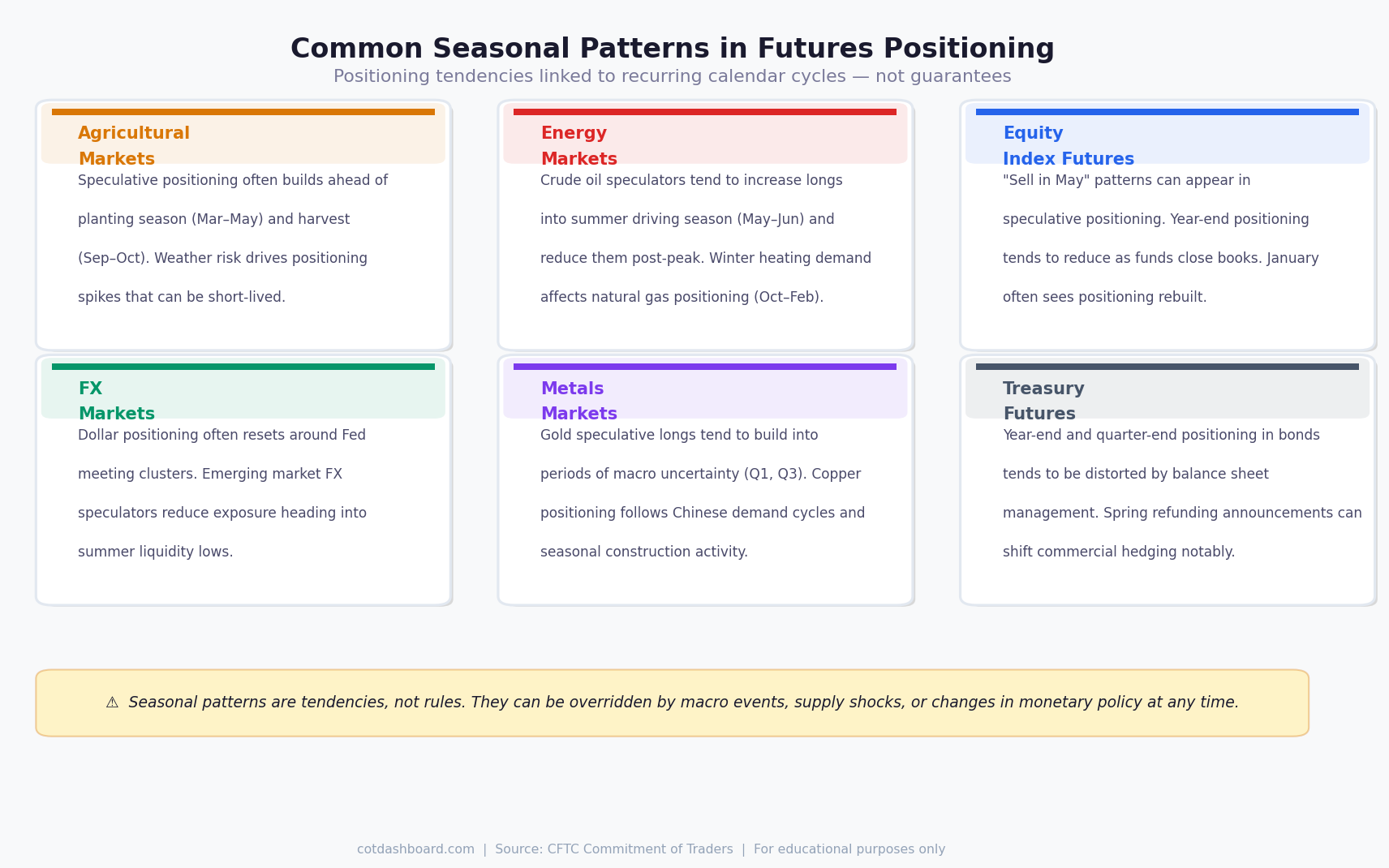
Grains (corn, wheat, soybeans): Speculative positioning tends to build ahead of planting season (March–May) as traders take views on expected supply. Positioning often peaks or reverses around key USDA crop reports in May and June. A second positioning cycle occurs around harvest (September–October) as actual yields become known.
Weather uncertainty is the primary driver of positioning spikes in agricultural markets. A drought forecast in the US Midwest can compress a multi-month positioning build into days.
Soft commodities (coffee, cotton, sugar): Similar harvest-driven cycles apply, but the specific timing depends on the crop's growing region and season. Brazilian sugar and coffee harvests (March–May) drive a different seasonal pattern than US cotton harvest (October).
Energy Markets
Energy futures have two dominant seasonal drivers: summer driving demand and winter heating demand.
Crude oil: Speculative long positions often begin building in March–April in anticipation of peak summer driving season (June–August). US refineries increase crude purchases to produce summer gasoline, creating commercial demand that supports prices. Speculative longs frequently peak in May–June and then reduce into autumn.
Natural gas: The pattern runs opposite to crude. Speculative positioning builds ahead of winter heating season (October–November) and tends to unwind in spring. Summer storage injection data (April–October) also drives periodic positioning adjustments.
These patterns are well-known and frequently priced in by markets. A positioning build into summer driving season is "expected" — an unexpected disruption (refinery outage, geopolitical event) is what drives the real move.
Equity Index Futures
Equity positioning shows several calendar tendencies:
Year-end reduction: December often sees speculative positions in equity index futures decline as funds lock in returns, reduce risk, and manage year-end redemptions. This creates a structural headwind for equity futures positioning regardless of market direction.
January rebuild: Position reduction in December is frequently followed by rebuilding in January as funds re-establish directional exposure. This can exaggerate January equity market moves in either direction.
Summer seasonality: The "sell in May" pattern — reduced equity performance and positioning from May through September — has a weak but recurring statistical basis. Institutional traders are aware of it, which partly explains why it persists and partly why it periodically fails.
FX Markets
FX positioning seasonality is less pronounced than commodities but still observable:
US dollar: Dollar positioning tends to be influenced by the Federal Reserve meeting schedule. Periods with clustered Fed meetings (March, June, September, December) often see larger positioning adjustments than quieter months.
Emerging market currencies: Speculative exposure to EM currencies typically reduces into the northern hemisphere summer as liquidity falls and risk appetite decreases. This is a tendency, not a reliable rule.
Metals Markets
Gold: Speculative long positioning in gold tends to build during periods of elevated macro uncertainty, which historically cluster in Q1 (after year-end repositioning) and Q3 (pre-US election years). Physical demand from India and China around festival seasons (October–November) provides additional seasonal support.
Copper: Copper positioning follows Chinese demand cycles more than a simple calendar. The Chinese New Year (January–February) typically marks a construction slowdown that reduces copper demand, often reflected in positioning. Q2 tends to see positioning rebuild as Chinese construction activity resumes.
How to Use Seasonal Patterns with COT Data
The most defensible application of seasonal patterns is as context, not as a primary signal.
A useful question is: "Is current positioning consistent with or diverging from typical seasonal behaviour?"
If speculative crude oil longs are building in March–April (consistent with seasonal norms), that tells you relatively little — the pattern is expected. If they are declining sharply in March–April (against seasonal norms), that is worth examining further. Something is overriding the usual cycle.
Seasonal analysis works best when:
- The current positioning is notably different from seasonal expectations
- The divergence aligns with a fundamental change in supply, demand, or monetary conditions
- The seasonal pattern has been consistent across multiple years, not just one or two
Limitations of Seasonal Analysis
Seasonal patterns in COT data are derived from historical averages. Individual years deviate significantly from those averages.
COVID-19 in 2020 obliterated seasonal patterns across virtually every futures market simultaneously. The 2022 energy shock from the Ukraine conflict overrode normal crude oil and natural gas seasonal cycles completely.
Seasonal patterns are also self-defeating to some degree. As more traders become aware of a seasonal tendency, they position earlier to capture it — which gradually erodes the pattern's timing and magnitude.
Use seasonal context as one factor among several, weighted less heavily than current fundamentals and price action.
For related reading, see How Hedge Funds Use COT Data and Do Extreme COT Positions Predict Reversals?